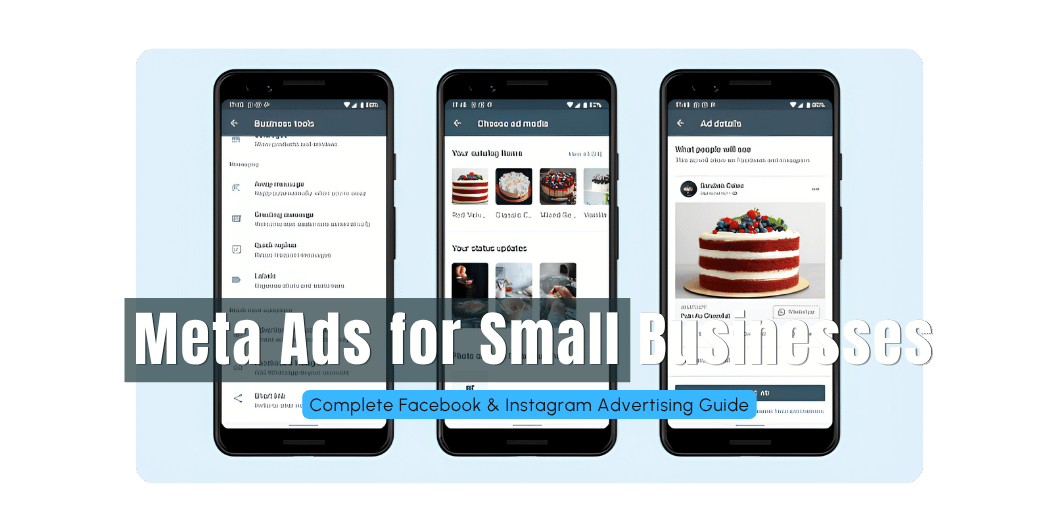
Meta Ads for Small Businesses: Complete Facebook & Instagram Advertising Guide for 2026
Introduction
Facebook and Instagram are no longer just platforms for posting photos and updates.
For small businesses, they can also be powerful advertising channels for:
- Building brand awareness
- Generating leads
- Promoting products
- Driving website traffic
- Increasing enquiries
- Promoting events
- Reaching local customers
- Retargeting website visitors
- Supporting eCommerce sales
This is where Meta Ads comes in.
Meta’s advertising ecosystem allows businesses to create paid campaigns that can reach audiences across Meta’s platforms and available placements.
But successful Meta advertising isn’t simply about:
Create an ad → Add money → Get sales
A successful campaign requires a combination of:
Audience + Creative + Offer + Landing Page + Tracking + Optimization
This guide explains how Meta Ads work for small businesses in 2026, what types of campaigns you can run, how much to budget, how to create better ads, how to target audiences, how to measure results and how to avoid common mistakes.
What Are Meta Ads?
Meta Ads are paid advertisements delivered through Meta’s advertising ecosystem.
Depending on campaign setup and available placements, advertisements can appear across platforms such as:
- Reels
- Stories
- Other Meta-supported placements
Businesses can advertise:
- Products
- Services
- Websites
- Offers
- Events
- Videos
- Lead-generation forms
- Apps
The advertising system uses campaign objectives, audience signals, creative assets and other inputs to help deliver ads to people who may be more likely to take the desired action.
Why Should Small Businesses Use Meta Ads?
One major advantage of Meta advertising is the ability to combine audience targeting with visual storytelling.
Consider a clothing business.
A Google search such as:
“buy women’s kurti online”
captures existing search demand.
But on Instagram, the business can show a Reel featuring:
- New arrivals
- Models wearing the products
- Different colors
- Styling ideas
- A limited-time offer
The customer may not have been searching for the product at that moment.
The advertisement can create interest.
That’s one of the important differences between search advertising and social advertising.
Meta Ads vs Organic Social Media
Posting organically and running paid advertising are different strategies.
Organic social media
You publish content and rely on:
- Existing followers
- Shares
- Engagement
- Algorithmic distribution
- Community interaction
Meta Ads
You pay to distribute advertising to selected audiences through Meta’s advertising system.
A strong social media strategy can use both.
For example:
Organic content → Build credibility
Paid ads → Expand reach and generate specific actions
Meta Ads vs Google Ads
Our previous article compared the two platforms in detail:
Google Ads vs Meta Ads: Which Advertising Platform Should Small Businesses Use in 2026?
The basic difference is:
Google Ads
Often captures people who are actively searching.
Meta Ads
Can help businesses discover and reach audiences while they are consuming social content.
For example:
Google:
“digital marketing agency Kolkata”
Meta:
A business owner sees a Reel about improving their online presence.
Both can eventually lead to a customer.
The journey is simply different.
Meta Ads Campaign Objectives
Your campaign objective should reflect the business outcome you want.
Depending on the current Meta Ads interface and available campaign options, objectives can include goals related to:
- Awareness
- Traffic
- Engagement
- Leads
- App promotion
- Sales
The exact options and campaign structure can change over time.
Don’t choose an objective simply because it sounds attractive.
Choose the objective that aligns with your actual business goal.
1. Awareness Campaigns
Awareness campaigns are designed to help businesses reach people and increase recognition.
They can be useful for:
- New brands
- Product launches
- Local businesses
- Events
- Brand campaigns
For example:
A new restaurant opening in Kolkata might use video advertising to introduce:
- The location
- Interior
- Food
- Brand identity
- Opening offer
The objective isn’t necessarily immediate sales from every impression.
It can be about making more people aware of the business.
2. Traffic Campaigns
Traffic campaigns focus on sending people to destinations such as:
- Website
- Landing page
- App
- Other supported destinations
Traffic can be useful when website visits are an important part of your marketing strategy.
However, don’t confuse:
More traffic
with:
More customers
If your goal is lead generation or sales, measure those outcomes as well.
3. Engagement Campaigns
Engagement-focused campaigns can help businesses promote content and encourage interactions where appropriate.
They can be useful for:
- Content promotion
- Community activity
- Video engagement
- Event-related campaigns
But likes and comments should not be treated as direct substitutes for revenue.
4. Lead Generation Campaigns
Lead campaigns can be particularly useful for service businesses.
Potential leads may provide information such as:
- Name
- Phone
- Business requirement
Depending on the campaign setup, businesses may use instant forms or direct users to a website.
Lead campaigns can be useful for:
- Real estate
- Education
- Digital marketing
- Insurance
- Professional services
- Local businesses
- B2B services
The important metric is qualified leads, not simply the number of forms submitted.
5. Sales Campaigns
Sales-focused campaigns are designed around purchasing or other valuable conversion actions.
They can be useful for:
- eCommerce
- Product businesses
- Online stores
- Catalog-based businesses
- Businesses with measurable purchase events
Strong tracking is especially important for these campaigns.
Choosing the Right Meta Ads Objective
Start with your actual business objective.
| Business Goal | Potential Campaign Focus |
|---|---|
| Build awareness | Awareness |
| Send visitors to website | Traffic |
| Promote content | Engagement |
| Generate enquiries | Leads |
| Generate purchases | Sales |
| Promote a new brand | Awareness + other relevant campaigns |
| Local event promotion | Awareness/Engagement/Traffic depending on goal |
The exact campaign setup should be based on your current Meta Ads account options and business requirements.
Meta Ads Targeting
One of the key parts of Meta advertising is audience selection.
Depending on available features, advertisers can use signals such as:
- Location
- Age
- Demographics
- Interests
- Website activity
- Customer lists
- Engagement
- Other audience signals
- Automated audience systems
Meta’s targeting capabilities and available controls can change over time.
Therefore, don’t build your strategy around an assumption that a specific targeting option will always be available.
Local Business Targeting
Local businesses can use geographic targeting to focus advertising on areas they actually serve.
For example:
A Kolkata restaurant might target:
- Kolkata
- Nearby neighborhoods
- Specific service radius
A local IT support company may target businesses in its actual service area.
A showroom may focus advertising around the geographic market from which customers realistically travel.
Don’t automatically target an entire state or country if your business operates locally.
Interest-Based Targeting
Interest signals can sometimes help advertisers reach relevant audiences.
For example, a business selling professional photography equipment might explore relevant audience signals around:
- Photography
- Cameras
- Video production
- Content creation
However, interest targeting shouldn’t replace measurement.
Always evaluate whether the audience generates meaningful business outcomes.
Custom Audiences
Businesses may be able to create audiences based on their own customer or website data, subject to Meta’s requirements and applicable privacy rules.
Examples can include:
- Website visitors
- Customer lists
- People who interacted with content
- Previous customers
- App activity
These audiences can be useful for remarketing and customer retention strategies.
Always ensure that your data collection and advertising practices comply with applicable privacy laws and platform requirements.
Lookalike-Style Audiences
Meta has historically offered tools that help advertisers reach people who resemble existing audiences.
The exact implementation and terminology can change over time.
The basic concept is:
Start with a relevant source audience → identify similar audience signals → reach additional potential customers.
The quality of the source audience matters.
A list of highly valuable customers may provide more useful signals than a large list of unqualified leads.
Meta Ads Creative: The Most Important Part?
Creative is extremely important in social advertising.
Unlike search advertising, users aren’t necessarily looking for your product when they see the advertisement.
You need to stop the scroll.
A strong creative should quickly communicate:
- What is this?
- Why should I care?
- What problem does it solve?
- What should I do next?
1. Use Strong Visuals
Your image or video should immediately communicate the subject.
For example:
Restaurant
Show the food.
Clothing brand
Show the product being worn.
Real estate
Show the property.
Digital agency
Show real project examples or a clear service benefit.
IT company
Show the solution or problem being solved.
Avoid generic stock imagery when real business visuals would be more convincing.
2. Use Short Video
Short-form video is particularly useful for Facebook and Instagram advertising.
A simple structure can be:
0–3 seconds
Hook
3–8 seconds
Problem
8–15 seconds
Solution
15–20 seconds
Proof/benefit
Final seconds
CTA
The exact duration isn’t important as long as the content communicates the message efficiently.
3. Create Different Creative Formats
Don’t rely on one image.
Test:
- Reels
- Square images
- Vertical videos
- Stories
- Carousel
- Product demonstrations
- Testimonials
- Before/after visuals where appropriate
Different formats may work differently across placements.
4. Write Better Ad Copy
A simple structure is:
Problem → Solution → Benefit → CTA
For example:
Problem
Struggling to generate consistent leads online?
Solution
Build a structured digital marketing strategy with SEO, Google Ads and social media campaigns.
Benefit
Reach relevant audiences and track meaningful business results.
CTA
Get Started
Keep claims accurate and avoid guarantees.
5. Use a Strong Hook
The first line or first few seconds can determine whether people continue paying attention.
Examples:
“Still relying only on referrals?”
“Your website may be losing customers.”
“Launching a new product?”
“5 website mistakes small businesses make.”
The hook should be relevant to the audience and supported by the rest of the advertisement.
Meta Ads Budget for Small Businesses
There is no universal Meta Ads budget.
Your costs can vary based on:
- Audience
- Competition
- Location
- Campaign objective
- Creative quality
- Seasonality
- Offer
- Conversion rate
Instead of asking:
“How much should I spend?”
start with:
“How much can I afford to spend to acquire a customer profitably?”
Example Meta Ads Budget
Suppose a business has:
₹30,000 monthly advertising budget.
You could use a controlled testing approach rather than spending the entire budget immediately.
For example:
Week 1: Test creative and audience combinations
Week 2: Identify promising signals
Week 3: Improve campaigns
Week 4: Evaluate qualified leads/sales
These are planning examples, not guaranteed performance timelines.
Cost Per Lead
Suppose:
Advertising spend = ₹20,000
Leads = 40
Cost per lead:
₹500
But don’t stop there.
If only 5 leads are qualified, your:
Cost per qualified lead = ₹4,000
That may tell a completely different story.
Customer Acquisition Cost
For many businesses, the most important number is:
Customer Acquisition Cost (CAC)
A simplified formula:
CAC = Advertising & Acquisition Cost ÷ New Customers
For example:
₹30,000 advertising spend
6 new customers
CAC = ₹5,000
Whether ₹5,000 is acceptable depends on the economics of your business.
Meta Ads for eCommerce
Meta Ads can be particularly useful for visual products.
Examples:
- Fashion
- Beauty
- Food
- Home decor
- Accessories
- Fitness products
- Consumer electronics
- Lifestyle products
A product advertisement can show:
Problem → Product → Demonstration → Benefit → Offer → CTA
Product Creative Example
Suppose you’re selling a premium office chair.
Video
Show:
- Person sitting uncomfortably
- Product introduction
- Chair adjustment
- Close-up details
- Workspace transformation
- Product information
- CTA
This communicates more than a generic:
“Buy our office chair today.”
Meta Ads for Service Businesses
Service businesses need a slightly different approach.
Instead of focusing entirely on the service name, focus on the customer’s problem.
For example:
Weak
SEO Services Available
More useful
Not Getting Enough Local Customers From Google?
Then explain:
- What the problem is
- How your service helps
- What the process looks like
- What action the visitor can take
Meta Ads for Local Businesses
Local businesses can combine:
Location + Offer + Creative + CTA
For example:
Restaurant
Weekend Special in Salt Lake
Gym
New Membership Plans in Kolkata
Showroom
Book Your Test Ride
Pharmacy
Order Your Medicines Online
Make sure any promotional or regulated claims comply with applicable laws and platform policies.
Meta Ads Retargeting
Retargeting can help reconnect with people who previously interacted with your business, where eligible and properly configured.
For example:
Visitor sees product
↓
Doesn’t purchase
↓
Later sees reminder advertisement
↓
Returns to website
↓
Completes purchase
This can be useful because the person already knows your business.
However, frequency and creative fatigue should be monitored.
Creative Fatigue
If the same advertisement is shown repeatedly to the same audience, performance can decline.
Signs may include:
- Declining engagement
- Increasing costs
- Lower click-through rates
- Lower conversion rates
- Audience complaints or negative feedback
One solution is to create multiple creative variations.
For example:
Creative A
Product demonstration
Creative B
Customer testimonial
Creative C
Problem/solution
Creative D
Offer
Creative E
Educational Reel
How Many Meta Ads Should You Create?
There is no magic number.
Instead of creating dozens of nearly identical ads, create meaningful variations.
Test different:
- Hooks
- Visuals
- Offers
- Headlines
- CTAs
- Formats
Then use performance data to determine what deserves further investment.
Meta Ads Landing Pages
The advertisement is only one part of the conversion process.
After someone clicks, the landing page should match the advertisement.
For example:
Ad:
“Professional Business Website Development”
Landing page:
“Business Website Development Services”
The user should immediately recognize the connection.
For more information, read:
Google Ads Landing Page Optimization
The same fundamental landing-page principles can apply to Meta traffic.
Meta Ads Conversion Tracking
Tracking is essential.
Depending on your campaign, you may want to measure:
- Website visits
- Leads
- Purchases
- Add to cart
- Checkout
- Registration
- Phone calls
- Other meaningful actions
For eCommerce, purchase and revenue tracking are particularly important.
For service businesses, track:
Lead → Qualified Lead → Customer
rather than only counting form submissions.
Meta Pixel and Other Measurement Tools
Meta provides tools for measuring website activity and advertising performance.
The exact implementation depends on your website and current Meta technology.
Businesses may use:
- Meta Pixel
- Conversions API
- Website events
- CRM integrations
- Other supported measurement tools
Implementation should be tested carefully.
Incorrect configuration can cause:
- Missing conversions
- Duplicate conversions
- Incorrect attribution
- Poor campaign optimization
Meta Ads and WooCommerce
For WooCommerce stores, a useful measurement journey is:
Ad Impression
↓
Product View
↓
Add to Cart
↓
Checkout
↓
Purchase
↓
Revenue
If many people reach checkout but don’t purchase, investigate:
- Shipping costs
- Payment options
- Checkout complexity
- Website speed
- Trust
- Product information
Advertising may not be the actual problem.
Google Ads + Meta Ads Strategy
The two platforms don’t have to compete.
They can work together.
For example:
Meta Ads
Introduce your brand.
↓
Website
Educate visitors.
↓
Retargeting
Reconnect with interested users.
↓
Google Search
Capture users who later search for your service.
↓
Conversion
Generate a lead or sale.
This is only one possible customer journey.
SEO + Meta Ads
SEO can also support your social advertising strategy.
Imagine you publish a useful article:
“How Much Does a Business Website Cost in India?”
You can:
- Rank it organically
- Share it on social media
- Promote it through Meta Ads
- Use it to educate potential customers
- Retarget eligible visitors
This creates more value from a single content asset.
15 Meta Ads Strategies for Small Businesses
Let’s summarize the most practical strategies.
1. Define one clear objective
Don’t try to achieve everything with one campaign.
2. Understand your audience
Know who you’re trying to reach.
3. Use strong creative
Visual quality matters.
4. Test different hooks
The first few seconds are important for video.
5. Match the landing page
Keep the message consistent.
6. Track conversions
Don’t rely only on likes.
7. Measure lead quality
More leads aren’t automatically better.
8. Test multiple creative formats
Use images, video, Reels, carousels and other relevant formats.
9. Refresh creative
Avoid excessive creative fatigue.
10. Use retargeting where appropriate
Reconnect with eligible engaged audiences.
11. Test your offer
Sometimes the problem isn’t targeting—it is the offer.
12. Improve your website
A poor landing page can waste good advertising.
13. Monitor frequency and audience response
Watch for signs of fatigue.
14. Compare customers, not just clicks
Customer acquisition cost matters.
15. Scale carefully
Don’t dramatically increase budget without understanding campaign economics.
Common Meta Ads Mistakes
1. Boosting every post
Boosting isn’t automatically the same as running a strategic campaign.
2. Using poor creative
Weak visuals can make it difficult to capture attention.
3. Measuring likes as success
Engagement isn’t necessarily revenue.
4. No conversion tracking
You don’t know what happens after the click.
5. Sending everyone to the homepage
Use relevant destinations.
6. Targeting too broadly
Large audiences aren’t automatically valuable.
7. Over-targeting
Extremely narrow audiences can also restrict delivery.
8. Running one creative forever
Creative fatigue can reduce performance.
9. Ignoring lead quality
Cheap leads may be poor leads.
10. Scaling too quickly
More budget doesn’t guarantee proportionally more customers.
Meta Ads Optimization Checklist
Strategy
- Clear business objective
- Target customer defined
- Offer defined
- Customer journey understood
Creative
- Strong visual
- Clear hook
- Relevant copy
- Clear CTA
- Multiple variations
Targeting
- Location configured
- Relevant audience signals
- Existing customer audiences where appropriate
- Retargeting considered
Website
- Relevant landing page
- Mobile-friendly
- Fast loading
- Clear CTA
- Trust signals
Measurement
- Conversion tracking
- Lead tracking
- Sales tracking
- Revenue tracking where possible
- Customer acquisition cost
How to Evaluate Meta Ads Performance
Don’t ask only:
“How many people saw my ad?”
Ask:
Awareness
How many relevant people did we reach?
Engagement
Did people interact with the content?
Traffic
Did people visit the website?
Leads
Did people enquire?
Quality
Were those enquiries relevant?
Sales
Did they become customers?
Revenue
How much business did the campaign generate?
Profitability
Did the economics make sense?
This creates a much more complete picture.
Final Thoughts
Meta Ads can be a powerful tool for small businesses, especially when the business has:
- Strong visual content
- A clearly defined audience
- An attractive offer
- A good website
- Reliable conversion tracking
- A structured optimization process
But advertising success doesn’t come from simply spending more money.
It comes from understanding the customer journey.
Audience → Creative → Click → Landing Page → Lead/Sale → Customer
Start with a clear objective.
Create relevant and engaging creative.
Test different messages.
Use appropriate audience signals.
Build a strong landing page.
Track meaningful conversions.
Measure qualified leads and customers.
Then improve your campaigns based on actual data.
And remember:
A successful Meta Ads campaign isn’t necessarily the campaign with the most likes, clicks or cheapest traffic. It’s the campaign that contributes meaningfully to your business objective.
Frequently Asked Questions
What are Meta Ads?
Meta Ads are paid advertisements delivered through Meta’s advertising ecosystem, including Facebook and Instagram and other supported placements.
Are Meta Ads good for small businesses?
They can be. Meta Ads can be useful for brand awareness, product discovery, lead generation, local promotions, eCommerce and remarketing, depending on the business.
How much should a small business spend on Meta Ads?
There is no universal budget. Start with an amount you can afford to test and measure, then adjust based on qualified leads, customers and revenue.
Is Meta Ads better than Google Ads?
Neither platform is universally better. Google Ads often captures active search demand, while Meta can be useful for audience discovery, awareness and visual advertising.
Are Facebook Ads and Instagram Ads the same?
They are both part of Meta’s advertising ecosystem and can be managed through Meta’s advertising tools, although placements and user experiences differ.
What should I track in Meta Ads?
Track the actions that matter to your business, such as qualified leads, purchases, revenue, bookings or other meaningful conversions.
How often should I change Meta Ads creatives?
There is no fixed schedule. Monitor performance and audience response, and introduce fresh creative when existing ads show signs of fatigue or when you have new messaging to test.
Can Meta Ads generate sales without a website?
Some campaign formats can support lead generation or other actions without requiring a traditional website journey. However, the best setup depends on your business model and campaign objective.
Can I use Meta Ads and Google Ads together?
Yes. They can serve different roles within the same marketing strategy. Meta can support discovery and awareness while Google can capture active search demand.