Meta Ads Campaign Setup: Step-by-Step Guide for Facebook & Instagram Ads in 2026
Introduction
Facebook and Instagram remain important advertising channels for businesses that want to reach specific audiences, generate enquiries, promote products, or build awareness.
But creating a Meta ad is more than simply pressing “Boost Post.”
A properly structured Meta Ads campaign requires decisions about:
- Campaign objectives
- Target audience
- Location
- Budget
- Ad placements
- Creative formats
- Ad copy
- Landing pages
- Lead forms
- Conversion tracking
- Testing
- Performance optimization
For a small business, these decisions can make a significant difference to how efficiently the advertising budget is used.
This guide explains how to set up a Meta Ads campaign step by step in 2026, with practical examples for Indian small businesses.
If you are completely new to Meta advertising, you may also want to read our previous guide:
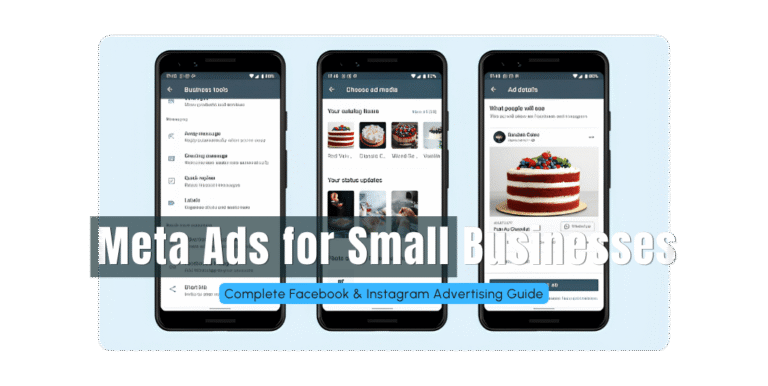
👉 Meta Ads for Small Businesses: Complete Facebook & Instagram Advertising Guide for 2026
What Is a Meta Ads Campaign?
A Meta Ads campaign is a paid advertising campaign created through Meta Ads Manager to advertise across Meta’s platforms and available placements.
Depending on the campaign setup, your ads can potentially appear across environments such as:
- Stories
- Reels
- Feed
- Other Meta placements where eligible
The basic structure has three levels:
| Level | Purpose |
|---|---|
| Campaign | Defines the overall advertising objective |
| Ad Set | Controls audience, budget, placements and schedule |
| Ad | Contains the image/video, copy, headline and CTA |
Think of it like this:
Campaign → Ad Set → Ad
For example:
Campaign: Generate Leads
↓
Ad Set: Kolkata + 10 km, relevant audience
↓
Ad: Promotional video + enquiry CTA
Understanding this structure is one of the first things beginners should learn.
Meta Ads Campaign Structure Explained
1. Campaign Level
At the campaign level, you decide what you want the advertising system to achieve.
Examples:
- Awareness
- Traffic
- Engagement
- Leads
- Sales
Your objective should match the actual business goal.
If your goal is to generate enquiries, creating a campaign optimized around the wrong outcome can make measurement and optimization more difficult.
2. Ad Set Level
The ad set determines who should see the advertisement and under what conditions.
Typical settings include:
- Audience
- Location
- Age
- Gender where relevant
- Placements
- Budget
- Schedule
- Conversion destination
- Optimization settings
This is where much of your campaign strategy is implemented.
3. Ad Level
The ad is what the customer actually sees.
It can contain:
- Image
- Video
- Primary text
- Headline
- Description where available
- Call-to-action button
- Destination URL
- Lead form
Your campaign strategy may be excellent, but poor creative can still result in weak engagement.
Step 1: Prepare Your Meta Business Setup
Before creating your first campaign, organize your business assets.
Depending on your business setup, you may need:
- Facebook Page
- Instagram account
- Meta business portfolio/business assets
- Ad account
- Payment method
- Website
- Tracking setup
- Product catalogue where applicable
Make sure your business information is accurate and your advertising assets are properly connected.
Basic preparation checklist
- Facebook Page created
- Instagram account connected
- Business assets organized
- Ad account available
- Payment method added
- Website ready
- Landing page tested
- Tracking planned
- Creative prepared
Don’t start spending money before checking these basics.
Step 2: Define Your Advertising Goal
Before opening Ads Manager, answer one simple question:
What action do I want the customer to take?
For example:
Local service business
Goal:
Generate enquiries from customers within Kolkata.
Possible campaign direction:
Leads
E-commerce business
Goal:
Generate online purchases.
Possible campaign direction:
Sales
New business
Goal:
Introduce the brand to a local audience.
Possible campaign direction:
Awareness
Content creator
Goal:
Increase video engagement.
Possible campaign direction:
Engagement
Your advertising objective should support the actual business outcome you are trying to achieve.
Step 3: Choose Your Campaign Objective
Meta provides different objectives for different marketing goals.
Common objectives include:
| Objective | Suitable For |
|---|---|
| Awareness | Brand visibility and reach |
| Traffic | Website visits or destination traffic |
| Engagement | Interactions, video views and social engagement |
| Leads | Enquiries, forms, calls or messages |
| Sales | Purchases and conversion-focused campaigns |
Example
Suppose you operate a digital marketing agency.
You don’t simply want people to visit your website.
You want qualified businesses to contact you.
In that situation, a lead-generation-focused campaign may be more aligned with your goal than simply optimizing for traffic.
Step 4: Give Your Campaign a Clear Name
Don’t leave campaigns with confusing default names.
Use a naming structure that helps you understand your account later.
For example:
META | LEADS | KOLKATA | WEBSITE | SEP-2026
An ad set could be:
Kolkata | 25-45 | Business Owners
And an ad:
Video 01 | Service Offer
A simple naming convention becomes extremely useful when you have multiple campaigns.
Step 5: Set Your Campaign Budget
Budget determines how much you are prepared to spend.
Depending on your campaign setup, you may work with a daily or lifetime budget.
Example planning
Suppose you allocate:
₹500/day
Then a rough 30-day planning figure would be:
₹500 × 30 = ₹15,000
Actual spending and delivery can vary depending on the campaign settings and platform delivery.
Don’t choose a budget simply because another advertiser is spending that amount.
Instead, start with a budget that is realistic for your business and sufficient for meaningful testing.
Step 6: Define Your Target Audience
Audience targeting is one of the most important parts of Meta advertising.
Start with your actual customer.
Ask:
- Where do they live?
- What age group are they?
- What problem do they have?
- What products or services do they need?
- What type of content might interest them?
- Are they consumers or business decision-makers?
- Do they need a local service?
Example: Local Dental Clinic
Targeting might focus on:
Location: Specific service area
Age: Based on the clinic’s customer profile
Creative: Dental service + local relevance
CTA: Book Appointment
You don’t necessarily need to target everyone in a city.
You want the audience to be relevant to the business.
Step 7: Set Your Location Targeting
For local businesses, location is particularly important.
Suppose you operate a service business in Kolkata.
You might define a service area around the locations you actually serve.
Examples:
- Kolkata
- Salt Lake
- New Town
- Rajarhat
- Specific postal areas
- A defined radius where appropriate
Avoid advertising nationwide if your business only serves one local area.
Local advertising example
Business: AC Service Provider
Service Area: Kolkata
Campaign: Leads
CTA: Call Now / WhatsApp / Lead Form
The campaign should reflect the actual operational area of the business.
Step 8: Choose Placements
Meta provides different placements across its ecosystem.
Depending on campaign eligibility and creative format, placements can include:
- Facebook Feed
- Instagram Feed
- Instagram Stories
- Instagram Reels
- Facebook Stories
- Other available placements
Meta may offer automated placement options designed to distribute delivery across available placements.
For beginners, don’t automatically remove placements just because they are unfamiliar.
Instead, consider:
- Whether your creative works in the placement
- Whether the placement reaches your target audience
- Whether conversion data supports keeping or changing it
Step 9: Prepare Your Ad Creative
Your creative is the part of the advertisement that stops the scroll.
Common formats include:
Single Image
Useful for:
- Offers
- Services
- Announcements
- Product promotions
Video
Useful for:
- Product demonstrations
- Reels
- Testimonials
- Before/after presentations
- Tutorials
- Brand storytelling
Carousel
Useful for:
- Multiple products
- Features
- Services
- Step-by-step information
Reels
Short vertical videos can be useful for mobile-first advertising and social discovery.
Step 10: Design for Mobile First
Most social advertising experiences are mobile-oriented.
Your creative should therefore be easy to understand on a smaller screen.
For vertical content, commonly used formats include:
9:16
For feed content, other aspect ratios may be appropriate depending on placement.
Good creative principles
- One clear message
- Strong visual hierarchy
- Readable text
- High-quality images
- Brand consistency
- Clear CTA
- Avoid unnecessary clutter
Don’t put ten different messages into one graphic.
Step 11: Write Your Ad Copy
A simple Meta ad can follow this structure:
Problem
Identify the customer’s problem.
Solution
Explain how your product or service helps.
Benefit
Explain why the customer should care.
CTA
Tell them what to do next.
Example
Primary Text:
Looking for professional website development for your business?
Get a modern, mobile-friendly website designed around your business goals.
Suitable for local businesses, service providers and growing brands.
Send us an enquiry to discuss your requirements.
CTA: Learn More / Contact Us
Keep the message clear rather than trying to make every possible claim.
Step 12: Create a Strong Call to Action
Your CTA should match the desired action.
Examples:
| Goal | Possible CTA |
|---|---|
| Website visit | Learn More |
| Product purchase | Shop Now |
| Lead generation | Sign Up |
| Enquiry | Contact Us |
| Appointment | Book Now |
| Service enquiry | Get Quote |
| Message campaign | Send Message |
Don’t use a CTA that doesn’t match the customer journey.
Step 13: Use a Relevant Landing Page
If your advertisement sends people to your website, the landing page should continue the same message.
For example:
Ad: Google Ads Management for Small Businesses
The landing page should immediately explain:
Google Ads Management
rather than sending users to an unrelated homepage.
Your landing page should generally include:
- Clear headline
- Service/product information
- Benefits
- Supporting details
- Trust signals
- CTA
- Contact or enquiry form
- Mobile-friendly layout
- Fast loading experience
You can learn more about this in our guide:
👉 Google Ads Landing Page Optimization: 15 Ways to Get More Leads in 2026
Step 14: Set Up Conversion Tracking
Advertising without measurement makes optimization difficult.
Depending on your campaign, you may want to measure:
- Website leads
- Purchases
- Form submissions
- Calls
- Messages
- Registrations
- Other valuable actions
For websites, Meta’s tracking technologies can help connect advertising activity with actions taken on your site, subject to implementation and applicable privacy requirements.
For eCommerce businesses, tracking purchase value can be especially useful.
Read our related guide:
👉 Google Ads Conversion Tracking: How to Track Leads, Sales & ROI in 2026
While that article focuses on Google Ads, many of the measurement principles—such as defining meaningful conversions and separating important actions from secondary interactions—are useful for broader paid-media planning.
Step 15: Add UTM Tracking
UTM parameters can help you understand where website traffic originates.
For example:
utm_source=facebook
utm_medium=paid_social
utm_campaign=meta_leads_sep_2026
This can help you analyze campaign traffic in analytics systems.
A consistent UTM naming system becomes increasingly useful as your advertising activity grows.
Step 16: Check Your Lead Form
If you’re using Meta’s lead-generation functionality, don’t ask for unnecessary information.
A simple form might request:
- Name
- Phone number
- Business requirement
Depending on the business, additional qualifying questions can be useful.
For example:
What service are you interested in?
- Website Development
- SEO
- Google Ads
- Meta Ads
- Social Media Management
This can help businesses understand what the enquiry is about before contacting the lead.
Step 17: Preview Every Ad
Before publishing, check the advertisement carefully.
Review:
Creative
- Is the image/video correct?
- Is the text readable?
- Is the branding correct?
Copy
- Any spelling mistakes?
- Is the offer clear?
- Is the CTA appropriate?
Destination
- Does the URL work?
- Does the landing page open correctly?
- Is it mobile-friendly?
Tracking
- Are the intended conversion events configured?
- Are UTMs correct?
A five-minute review can prevent avoidable mistakes.
Step 18: Launch the Campaign
Once everything is ready, publish the campaign.
However, launching the campaign does not mean you should immediately make multiple changes.
Allow enough time to collect useful information before making conclusions.
Monitor:
- Delivery
- Spend
- Reach
- Impressions
- Clicks
- Leads
- Purchases
- Cost per result
- Conversion rate
- Lead quality
The exact metrics that matter depend on the campaign objective.
What Should You Do During the First 7 Days?
Don’t judge a campaign solely by one day’s performance.
Instead, establish a monitoring routine.
Day 1–2
Check for obvious issues:
- Ads delivering?
- Tracking working?
- Landing page working?
- Unexpected audience?
- Broken links?
- Extremely poor-quality traffic?
Day 3–4
Look for early patterns:
- Which creative receives attention?
- Which audience segments are responding?
- Are leads relevant?
- Are there technical problems?
Day 5–7
Start reviewing:
- Cost per result
- Conversion rate
- Lead quality
- Creative performance
- Placement performance
- Website behaviour
Then make controlled changes rather than changing everything simultaneously.
Meta Ads Lead Generation vs Website Conversion
There are two common approaches for service businesses.
Option 1: Instant Lead Form
The user submits information directly through the advertising experience.
Advantages
- Simple user journey
- Less friction
- Useful for mobile users
- Quick enquiry process
Considerations
- Lead quality needs monitoring
- Follow-up speed matters
- Qualification may be required
Option 2: Website Landing Page
The user clicks the advertisement and visits your website.
Advantages
- More space to explain the service
- Better control over branding
- Can provide detailed information
- Useful for complex services
Considerations
- More steps
- Website speed matters
- Tracking must be implemented correctly
- Landing page quality becomes important
Neither approach is universally suitable. The right choice depends on the business, customer journey and campaign objective.
Meta Ads for E-Commerce Businesses
For an online store, the campaign structure may be different from a local service business.
You may need:
- Product catalogue
- Product feed
- Product images
- Product pages
- Purchase tracking
- Value/revenue tracking
- Remarketing strategy
Your product page should also be optimized.
You can read:
👉 WooCommerce Product Page Optimization: 15 Ways to Get More Sales in 2026
And for analytics:
👉 WooCommerce Analytics: 15 Key Metrics Every Store Owner Should Track in 2026
Meta Ads for Local Businesses
Local businesses should build campaigns around their service area.
Examples include:
- Restaurants
- Clinics
- Salons
- Gyms
- Real estate businesses
- Coaching centres
- Repair/service providers
- Retail stores
- Event businesses
- Local professional services
A local campaign might combine:
Location + Service + Strong Creative + Clear CTA
For example:
Professional Website Design in Kolkata
Get a modern website for your business.
Contact Us
This is much more specific than:
“We provide digital solutions.”
How Much Should You Spend on Meta Ads?
There is no universal “correct” Meta Ads budget.
Your budget depends on:
- Industry
- Location
- Competition
- Audience size
- Customer value
- Conversion rate
- Sales cycle
- Campaign objective
- Creative quality
- Business capacity
A useful approach is to establish a test budget that the business can afford to spend while collecting meaningful data.
For example:
Test budget: ₹300–₹1,000/day
This is only a planning example, not a guaranteed recommendation for every business.
A business selling a ₹500 product and a business selling a ₹2 lakh service should not necessarily use the same advertising economics.
Important Meta Ads Metrics
Don’t focus only on likes and comments.
For lead-generation campaigns, useful metrics can include:
Cost Per Lead (CPL)
CPL = Advertising Spend ÷ Number of Leads
Example:
₹5,000 spend
50 leads
CPL = ₹100
But a cheap lead is not automatically a valuable lead.
Customer Acquisition Cost
A more useful business metric can be:
CAC = Total Marketing & Sales Cost ÷ New Customers
Suppose:
₹20,000 total marketing and sales cost
10 new customers
CAC = ₹2,000
Compare this against the customer’s value and margin.
Conversion Rate
If 1,000 people visit your landing page and 50 submit an enquiry:
Conversion Rate = 5%
Again, conversion rates vary significantly between industries and campaigns.
Don’t Optimize for Cheap Leads Alone
This is one of the most important lessons for service businesses.
Imagine two campaigns:
| Campaign | Leads | Cost/Lead | Qualified Leads |
|---|---|---|---|
| A | 100 | ₹50 | 8 |
| B | 50 | ₹100 | 20 |
Campaign A has a lower CPL.
But Campaign B may generate more qualified opportunities.
Therefore, businesses should track the journey:
Ad → Lead → Qualified Lead → Customer → Revenue
not just:
Ad → Lead
Common Meta Ads Campaign Mistakes
1. Boosting Everything
Not every post needs paid promotion.
Define the objective first.
2. Targeting Everyone
Broad targeting isn’t automatically wrong, but it should make sense for the campaign and business.
3. Too Many Audiences
Creating dozens of tiny ad sets can fragment testing and make analysis difficult.
4. Weak Creative
A poorly designed advertisement can reduce attention and response.
5. Sending Traffic to the Homepage
A dedicated landing page may provide a more focused user journey when the campaign requires it.
6. No Conversion Tracking
Without tracking, you may not know what generated meaningful business results.
7. Changing Campaigns Every Few Hours
Constant changes make it harder to understand what caused performance changes.
8. Ignoring Lead Quality
A large number of irrelevant enquiries isn’t necessarily successful advertising.
9. Using the Same Creative Forever
Audience response can change, and creative fatigue can become a concern.
Develop multiple creative variations.
10. Not Following Up Quickly
Advertising generates the opportunity.
Your sales process converts it.
A strong campaign cannot compensate for consistently poor lead follow-up.
A Simple Meta Ads Campaign Example
Let’s take a fictional Kolkata-based website development company.
Business Goal
Generate website development enquiries.
Campaign
Objective: Leads
Location
Kolkata service area
Audience
Relevant business audience based on the company’s customer profile
Creative
Short vertical video showing:
- Website designs
- Mobile responsiveness
- Business websites
- CTA
Primary Text
Need a professional website for your business?
Get a modern, mobile-friendly website designed for your business goals.
Send us your requirements and let’s discuss your project.
CTA
Get Quote / Contact Us
Landing Page
Dedicated website development service page
Conversion
Enquiry form submission
Measurement
Track:
Ad Spend → Leads → Qualified Leads → Customers → Revenue
This gives the business a complete view of campaign performance.
Meta Ads Campaign Setup Checklist
Before launching your campaign, use this checklist.
Business Setup
- Facebook Page connected
- Instagram connected
- Business assets organized
- Ad account ready
- Payment method added
Campaign
- Objective selected
- Campaign name created
- Budget decided
- Campaign settings reviewed
Audience
- Location selected
- Customer profile defined
- Audience strategy decided
- Targeting reviewed
Creative
- Image/video prepared
- Correct format used
- Branding checked
- Primary text written
- Headline written
- CTA selected
Landing Page
- URL tested
- Mobile layout checked
- Page speed checked
- CTA visible
- Form tested
Tracking
- Conversion events configured
- Analytics checked
- UTM parameters added where appropriate
- Lead/purchase tracking tested
Launch
- Preview checked
- Spelling checked
- Links checked
- Budget checked
- Campaign published
How to Optimize Your Meta Ads Campaign
After launch, optimization should be based on evidence.
A simple workflow is:
Measure → Identify Problem → Make One Controlled Change → Measure Again
For example:
Problem
Many clicks but few enquiries.
Investigate
Possible causes:
- Weak landing page
- Poor message match
- Slow website
- Wrong audience
- Weak CTA
- Low-intent traffic
Action
Improve the relevant part instead of immediately changing the entire campaign.
This approach makes campaign learning much easier.
Meta Ads + Google Ads: Should You Use Both?
Meta Ads and Google Ads serve different user behaviours.
Google Ads can capture people actively searching for products or services.
Meta Ads can reach people while they are browsing social content and can be useful for discovery, demand generation, remarketing and visual promotion.
For many businesses, they can work together.
For example:
Meta Ads → Awareness & Discovery
Google Ads → Search Intent
Website → Conversion
Remarketing → Re-engagement
You can read our detailed comparison:
👉 Google Ads vs Meta Ads: Which Advertising Platform Should Small Businesses Use in 2026?
Final Thoughts
A successful Meta Ads campaign setup starts before you publish the first advertisement.
You need a clear business objective, appropriate audience, suitable creative, relevant landing page, reliable tracking and a practical optimization process.
The basic structure is simple:
Campaign → Ad Set → Ad
But effective advertising comes from understanding what happens after someone sees the advertisement.
The complete journey is:
Audience → Creative → Click/Action → Landing Page/Form → Lead → Follow-Up → Customer → Revenue
For small businesses, this full journey is much more important than simply measuring likes, impressions or clicks.
Start with a clear objective, build a focused campaign, track meaningful conversions and make changes based on actual data.
FAQs About Meta Ads Campaign Setup
What is the first step in setting up Meta Ads?
The first practical step is to define the business goal. Decide whether you want awareness, traffic, engagement, leads or sales before configuring the campaign.
How much money do I need to start Meta Ads?
There is no universal minimum budget that guarantees useful results. Your test budget should be appropriate for your business, audience, objective and customer value.
Can I run Meta Ads only in Kolkata?
Yes. Local businesses can configure their campaigns around their actual service area rather than advertising to an unnecessarily large geographic audience.
Should I use Facebook Ads or Instagram Ads?
You don’t necessarily have to choose only one. Meta campaigns can potentially use placements across Facebook and Instagram depending on campaign configuration and eligibility.
Should I use images or videos?
Both can be useful. Choose the format that communicates your offer effectively and fits the placement and customer journey.
How long should I run a Meta Ads campaign?
There is no universal number of days. Give the campaign enough time to generate meaningful data, while monitoring for technical problems and clearly poor performance.
Why am I getting leads but not customers?
Possible reasons include poor lead quality, weak qualification, slow follow-up, pricing mismatch, sales-process problems or an offer that isn’t aligned with the audience.
Advertising performance should therefore be evaluated beyond CPL.
Can I run Meta Ads without a website?
Yes. Depending on the campaign objective, you can use options such as lead forms or messaging rather than always sending users to a website. However, the appropriate setup depends on your business and customer journey.