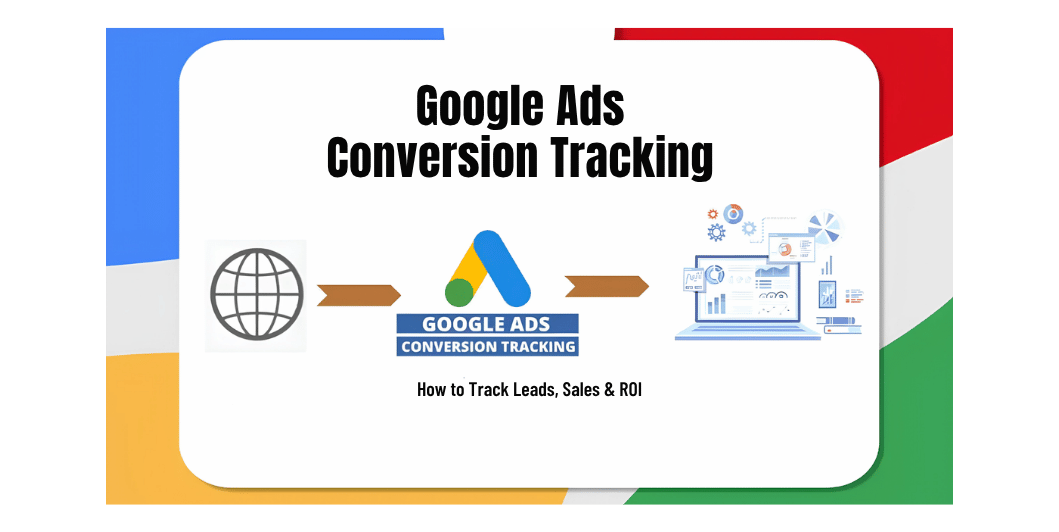
Google Ads Conversion Tracking: How to Track Leads, Sales & ROI in 2026
Introduction
Running Google Ads without conversion tracking is a little like running a shop without knowing which customers actually purchased.
You may know:
- How many people visited
- How many clicked
- How much you spent
But you may not know:
- How many people became leads
- Which campaigns generated those leads
- Which keywords generated sales
- How much each customer cost
- Which campaigns produced revenue
- Whether your advertising is actually profitable
That’s why Google Ads conversion tracking is one of the most important parts of PPC advertising.
For a small business, clicks and impressions are useful—but business outcomes are what ultimately matter.
A campaign generating 1,000 clicks isn’t necessarily better than one generating 200 clicks.
If the 200-click campaign generates more qualified customers, it may be considerably more valuable.
In this guide, we’ll explain conversion tracking in simple terms and show how small businesses can measure:
Clicks → Leads → Qualified Leads → Customers → Revenue → ROI
What Is Google Ads Conversion Tracking?
Google Ads conversion tracking is the process of measuring actions that matter to your business after people interact with your advertisements.
A conversion could be:
- A purchase
- Contact form submission
- Phone call
- Appointment booking
- Quote request
- Demo request
- Sign-up
- Newsletter registration
- WhatsApp enquiry
- Store visit or other offline action, depending on the business and available measurement setup
The important point is:
A conversion should represent a meaningful business action—not simply any interaction.
Why Conversion Tracking Matters
Imagine you spend:
₹25,000 on Google Ads
and receive:
500 clicks
Without conversion tracking, you might conclude:
“The campaign is getting traffic.”
But suppose only:
5 people contacted you
and just:
1 became a customer.
Now you have a much more useful picture.
You can begin asking:
- Was the keyword targeting correct?
- Was the advertisement relevant?
- Was the landing page effective?
- Were the leads qualified?
- Was the customer profitable?
- Should the campaign be changed?
Conversion tracking turns advertising data into actionable business information.
The Google Ads Measurement Funnel
A useful way to think about PPC measurement is:
Impressions
↓
Clicks
↓
Landing Page Visits
↓
Conversions
↓
Qualified Leads
↓
Customers
↓
Revenue
↓
Profit
Each stage tells you something different.
1. Impressions
An impression means your advertisement was shown.
A high number of impressions can indicate that your campaign is reaching a large search audience.
But impressions alone don’t tell you whether those people are interested in becoming customers.
2. Clicks
A click means someone interacted with your advertisement.
Clicks are useful for understanding traffic generation.
But:
Click ≠ Lead
and:
Lead ≠ Customer
This distinction is extremely important.
3. Landing Page Visits
After clicking your advertisement, the visitor reaches your website or landing page.
Now the landing page needs to do its job.
It should:
- Match the advertisement
- Explain the offer
- Build trust
- Provide useful information
- Make the next action obvious
Read our previous guide:
Google Ads Landing Page Optimization
4. Conversions
A conversion occurs when a user completes an action you’ve defined as valuable.
Examples:
Service Business
- Contact form
- Phone call
- Consultation request
eCommerce
- Purchase
- Checkout completion
SaaS
- Trial registration
- Demo request
Local Business
- Call
- Appointment
- Direction request where measurable
The correct conversion depends on the business model.
Primary vs Secondary Conversions
Not every conversion should necessarily have the same importance.
You can distinguish between actions that directly represent business value and actions that are useful but less important.
Primary conversion
For an eCommerce store:
Purchase
Secondary conversion
Newsletter signup
Similarly, for a service company:
Primary
Qualified enquiry
Secondary
Brochure download
This distinction helps prevent your campaigns from optimizing toward low-value actions when your real objective is customer acquisition.
What Should Small Businesses Track?
The answer depends on your business.
Service Business
Track:
- Lead forms
- Calls
- Consultation bookings
- Quote requests
- WhatsApp enquiries where appropriate
- Qualified leads
- Customers
eCommerce
Track:
- Product views
- Add to cart
- Checkout
- Purchases
- Revenue
Local Business
Track:
- Calls
- Appointment requests
- Website enquiries
- Relevant local actions where measurable
B2B Business
Track:
- Demo requests
- Contact forms
- Qualified leads
- Sales opportunities
- Closed customers
- Revenue
Google Ads Conversion Tracking vs Google Analytics
These tools can work together, but they serve different purposes.
Google Ads focuses heavily on advertising performance and campaign optimization.
Google Analytics provides broader website and user-behavior measurement.
For many businesses, connecting their measurement systems can provide a more complete picture.
For example:
Google Ads
→ How did the advertising campaign perform?
Analytics
→ What did users do on the website?
CRM/Sales system
→ Which leads became customers?
This creates a stronger measurement chain.
Website Conversion Tracking
One of the most common conversion types is a website form.
For example:
Google Ad
↓
Service Landing Page
↓
Contact Form
↓
Thank-you/confirmation
↓
Lead
You can configure tracking so that a successful form submission is recorded as a conversion.
However, make sure the event represents an actual successful submission—not simply a button click.
Phone Call Tracking
Phone calls can be extremely important for local and service businesses.
For example:
A person searches:
“digital marketing agency near me”
They see an advertisement and call the business.
If that call isn’t measured, your advertising data may understate the campaign’s value.
Depending on your setup and available Google Ads features, calls can be measured in different ways, including calls from ads and calls from website interactions.
For businesses where phone calls are a major source of customers, call tracking deserves special attention.
Form Submission Tracking
Suppose your website has a form:
Name
Phone
Requirement
Submit
The important event is the successful submission, not merely the visitor clicking the Submit button.
Otherwise, you could count:
- Invalid submissions
- Failed submissions
- Spam
- Accidental clicks
as conversions.
Always test your implementation.
Purchase Tracking for eCommerce
For an online store, purchase tracking is particularly important.
Instead of simply measuring:
“Product page viewed”
you ideally want to measure:
“Purchase completed.”
Depending on your setup, useful purchase information can include:
- Transaction value
- Currency
- Product information
- Order ID
- Quantity
This allows advertising performance to be evaluated against actual sales rather than website activity alone.
Track Revenue, Not Just Purchases
Suppose you receive two purchases.
Purchase A
₹1,000
Purchase B
₹25,000
Counting both as simply:
1 conversion
doesn’t provide the full picture.
For eCommerce businesses, tracking transaction value can make advertising analysis much more useful.
What Is Cost Per Conversion?
Cost per conversion tells you how much advertising spend is associated with each tracked conversion.
A simplified calculation is:
Cost per Conversion = Advertising Spend ÷ Conversions
For example:
₹20,000 spend ÷ 40 conversions = ₹500 per conversion
This is useful, but remember:
Not every conversion has equal value.
A ₹500 cost for a qualified customer may be excellent for one business and unacceptable for another.
Cost Per Lead vs Cost Per Customer
These are not the same.
Suppose:
Advertising spend = ₹30,000
Leads = 60
Cost per lead:
₹500
But only:
6 leads become customers
Cost per customer:
₹5,000
This distinction is critical.
A campaign can have a low cost per lead while having a high cost per customer.
Qualified Leads Matter
Not every enquiry is valuable.
Imagine a web development company receives:
100 enquiries
But:
- 30 are job enquiries
- 20 want free work
- 25 have requirements outside the company’s services
- 15 have unsuitable budgets
- 10 are genuine prospects
Looking only at:
100 leads
would give a misleading picture.
Instead, track:
100 enquiries → 10 qualified leads → actual customers
This is why lead qualification should be part of PPC measurement.
Customer Acquisition Cost
Customer Acquisition Cost, or CAC, measures the cost associated with acquiring customers.
A simplified calculation is:
CAC = Marketing & Sales Acquisition Cost ÷ New Customers
For example:
₹50,000 acquisition cost ÷ 10 new customers = ₹5,000 CAC
Your business should compare this with the economic value of those customers.
Customer Lifetime Value
A customer may purchase from your business more than once.
For example, a digital marketing client may pay monthly for several months.
A customer buying one ₹1,000 product is different from a customer generating ₹1,00,000 in revenue over their relationship with the business.
Therefore, Google Ads decisions should sometimes consider customer lifetime value, not only the first transaction.
What Is ROAS?
ROAS stands for:
Return on Ad Spend
A simplified formula is:
ROAS = Revenue Attributed to Advertising ÷ Advertising Spend
For example:
₹1,00,000 revenue ÷ ₹20,000 ad spend = 5x ROAS
That means ₹5 in attributed revenue for every ₹1 of advertising spend.
However, ROAS is not the same as profit.
You still need to consider:
- Product costs
- Salaries
- Shipping
- Taxes
- Agency fees
- Technology
- Returns
- Other operating expenses
A high ROAS doesn’t automatically mean high profit.
ROI vs ROAS
These terms are often confused.
ROAS
Focuses specifically on:
Revenue ÷ Ad Spend
ROI
Looks more broadly at the return relative to investment and may incorporate additional costs.
For example, if your campaign generates ₹1,00,000 in revenue from ₹20,000 ad spend, that’s a 5x ROAS.
But if your total business costs are ₹90,000, the profitability picture is very different.
Offline Conversion Tracking
Some businesses don’t complete the sales process online.
For example:
Google Ad → Website enquiry → Phone conversation → Sales meeting → Offline purchase
If you only track the website form submission, you may never know which leads actually became customers.
Where supported and properly configured, offline conversion measurement can help connect advertising interactions with later business outcomes.
This is particularly valuable for:
- B2B companies
- Real estate
- High-value services
- Education
- Professional services
- Long sales-cycle businesses
Why CRM Integration Matters
A CRM can help track:
Lead → Qualified → Proposal → Negotiation → Won/Lost
For example:
Lead
Customer fills out a form.
Qualified
Sales team determines the customer is a suitable prospect.
Opportunity
A commercial discussion begins.
Customer
The deal closes.
Connecting these stages to advertising data can give you a much better understanding of which campaigns produce actual business.
Don’t Count Spam as Real Conversions
Spam can distort your data.
For lead-generation websites, monitor:
- Duplicate enquiries
- Fake phone numbers
- Automated submissions
- Irrelevant requests
- Job enquiries
- Vendor messages
- Spam submissions
Your conversion numbers should represent meaningful customer actions as accurately as possible.
Common Google Ads Conversion Tracking Mistakes
1. Tracking clicks instead of conversions
A button click isn’t always a successful lead.
2. Tracking every page view as a conversion
A page view is usually not a business conversion.
3. Not tracking phone calls
This can hide valuable conversions for service businesses.
4. Ignoring offline sales
A lead may become a customer days or weeks later.
5. Counting duplicate conversions
Poor implementation can inflate numbers.
6. Not tracking transaction values
eCommerce businesses can lose important revenue information.
7. Tracking low-value actions as primary conversions
This can make campaign performance appear better than it actually is.
8. Never testing tracking
A conversion tag can break after a website change.
9. Ignoring lead quality
100 poor leads aren’t necessarily better than 20 qualified leads.
10. Optimizing purely for volume
More conversions don’t always mean more profitable customers.
How to Test Google Ads Conversion Tracking
Never assume your tracking works simply because you’ve installed it.
Test the complete journey.
Step 1
Search or access your advertisement using an appropriate testing approach.
Step 2
Click through to the landing page.
Step 3
Complete the conversion action.
For example:
Submit the enquiry form.
Step 4
Confirm the action is recorded correctly.
Step 5
Check your analytics/advertising reporting.
Step 6
Verify that duplicate or incorrect events aren’t being counted.
Also test on:
- Desktop
- Mobile
- Different browsers where appropriate
Google Ads Conversion Tracking for WordPress
If your website uses WordPress, tracking can be implemented through different technical approaches.
Depending on your setup, you may use:
- Google Tag Manager
- Google Analytics
- Google Ads conversion tags
- WordPress plugins
- Direct code implementation
- Form-specific integrations
The best method depends on your website, tracking requirements and technical setup.
Avoid installing multiple overlapping tracking systems without understanding what each one does.
Duplicate tags can create duplicate data.
Google Ads Conversion Tracking for WooCommerce
For WooCommerce stores, tracking should ideally cover the customer journey.
A useful measurement structure can include:
Product View
↓
Add to Cart
↓
Begin Checkout
↓
Purchase
↓
Revenue
This can help identify where users drop out.
For example:
If many users add products to their carts but very few complete checkout, the issue may not be the advertisement itself.
It could be:
- Shipping costs
- Checkout complexity
- Payment problems
- Lack of trust
- Slow website
- Unexpected fees
Our previous WooCommerce Cart Abandonment guide covers these issues in more detail.
Conversion Tracking and Landing Page Optimization
These two areas work together.
Suppose your campaign gets:
1,000 clicks
but only:
10 conversions
Your first question shouldn’t automatically be:
“Should I increase the budget?”
Instead investigate:
- Are the keywords relevant?
- Are the ads relevant?
- Is the landing page relevant?
- Is the offer competitive?
- Is the CTA clear?
- Is the page fast?
- Is the form working?
- Are users qualified?
Conversion data helps identify where the funnel needs attention.
A Practical Google Ads Measurement Dashboard
A small business can monitor a simple dashboard like this:
| Metric | Example |
|---|---|
| Ad Spend | ₹30,000 |
| Impressions | 50,000 |
| Clicks | 1,000 |
| CTR | 2% |
| Average CPC | ₹30 |
| Leads | 40 |
| Cost per Lead | ₹750 |
| Qualified Leads | 15 |
| Customers | 5 |
| Cost per Customer | ₹6,000 |
| Revenue | ₹1,00,000 |
| ROAS | 3.33x |
These are illustrative numbers only, not industry benchmarks.
The important point is to connect advertising spend to actual business outcomes.
What Should You Optimize First?
When a campaign isn’t performing well, work through the funnel.
Problem 1: Low impressions
Check:
- Search demand
- Targeting
- Budget
- Bidding
- Keyword coverage
Problem 2: Low clicks
Check:
- Ad relevance
- Messaging
- Search intent
- Competition
Problem 3: Many clicks but few conversions
Check:
- Landing page
- Offer
- CTA
- Form
- Website speed
- Mobile experience
Problem 4: Many leads but few customers
Check:
- Lead quality
- Sales follow-up
- Pricing
- Offer
- Customer qualification
Problem 5: Customers but poor profitability
Check:
- Customer acquisition cost
- Customer value
- Margins
- Average order value
- Repeat purchases
This approach prevents you from blindly changing campaigns.
Google Ads Conversion Tracking Checklist
Before launching your campaign:
Website
- Landing page works
- Forms work
- Phone numbers work
- Mobile experience tested
- Website loads efficiently
Tracking
- Google Ads conversion actions configured
- Analytics configured where appropriate
- Important forms tracked
- Calls tracked where appropriate
- Purchase tracking configured for eCommerce
- Revenue values captured where appropriate
Business
- Primary conversion defined
- Secondary conversions identified
- Lead qualification process defined
- Customer acquisition cost understood
- Revenue measurement available where practical
Testing
- Test conversion completed
- Data verified
- Duplicate tracking checked
- Mobile tested
- Thank-you/confirmation process tested
A Simple Conversion Tracking Strategy for Small Businesses
If you’re just starting, don’t make the system unnecessarily complicated.
For a service business
Start with:
Form submission + phone call
Then add:
Qualified lead → customer
when your sales process becomes mature enough to support it.
For eCommerce
Start with:
Purchase + revenue
Then analyze:
Add to cart → checkout → purchase
For B2B
Start with:
Lead → qualified lead
Then work toward:
Opportunity → customer → revenue
Start simple and improve your measurement over time.
Final Thoughts
Google Ads conversion tracking is not just a technical task.
It is the foundation of making better advertising decisions.
Without conversion data, you’re largely asking:
“How many people clicked?”
With proper measurement, you can ask:
“Which advertising activity generated valuable business?”
That’s a much more useful question.
Track the entire journey wherever practical:
Click → Lead → Qualified Lead → Customer → Revenue
Don’t optimize only for clicks.
Don’t celebrate low-cost leads without checking their quality.
Don’t assume a high ROAS automatically means high profit.
And don’t leave conversion tracking untouched after your website changes.
For small businesses in 2026, the goal should be simple:
Spend with purpose. Measure accurately. Learn from the data. Improve continuously.
Frequently Asked Questions
What is Google Ads conversion tracking?
It is the process of measuring valuable actions that happen after users interact with your Google Ads, such as purchases, enquiries, calls or bookings.
Why is conversion tracking important?
It helps you understand which campaigns and advertising activities are generating meaningful business outcomes rather than just clicks.
What should I track in Google Ads?
Track actions that matter to your business. For service businesses, these may include qualified enquiries and calls. For eCommerce, purchases and revenue are particularly important.
What is a good cost per lead?
There is no universal good number. It depends on your customer value, profit margins, sales conversion rate and business model.
What is a good ROAS?
There is no universal target. A ROAS that works for one business may not work for another because margins and operating costs differ.
Can I track phone calls from Google Ads?
Yes, Google provides call measurement options depending on the campaign and setup. Businesses that rely heavily on phone enquiries should include calls in their measurement strategy.
Can Google Ads track offline sales?
Offline conversion measurement can be used in appropriate setups to connect advertising interactions with later business outcomes. This is particularly useful for businesses with longer sales cycles.
Should I use Google Analytics with Google Ads?
They can complement each other. Google Ads provides advertising-focused reporting, while Analytics provides broader website and user-behavior information. The right setup depends on your measurement requirements.
How often should I check conversion tracking?
Review it regularly and whenever you make significant changes to your website, forms, checkout, analytics implementation or advertising setup.
Featured Image Text
GOOGLE ADS CONVERSION TRACKING
Track Leads, Sales & ROI in 2026
Measure • Optimize • Grow
Featured Image Concept
Create a premium 1200 × 675 px blog featured image with a modern PPC analytics theme.
Include:
- Laptop displaying a generic advertising analytics dashboard
- Conversion funnel
- Click → Lead → Customer → Revenue visual
- Target/bullseye
- Sales chart
- Tracking/tag icon
- Calculator
- Small business workspace
- Mobile phone showing a lead notification
Color theme: Dark navy + orange + white.
Keep the design professional, modern and clean with strong visual hierarchy. Use generic advertising/analytics elements rather than reproducing Google’s exact interface.