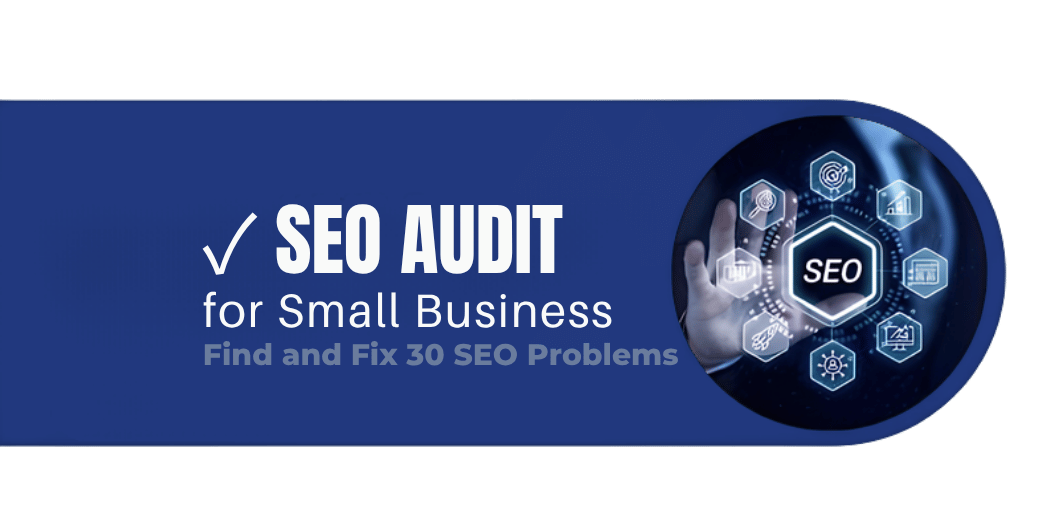
SEO Audit for Small Businesses: How to Find and Fix 30 SEO Problems in 2026
You have a website.
You publish blog posts.
You add keywords.
But is your website actually optimized for search engines?
Many small businesses invest time and money in SEO without regularly checking whether their website has technical errors, weak pages, broken links, indexing problems, poor content structure, or missed opportunities.
That’s where an SEO audit comes in.
An SEO audit is a systematic review of your website to identify problems and opportunities that could affect its search visibility, usability, and ability to attract relevant visitors.
You don’t need to be an enterprise company to perform one.
In fact, a regular SEO audit can be especially valuable for small businesses because it helps you focus limited resources on the areas that matter most.
In this guide, we’ll cover 30 SEO problems you should check in 2026, along with practical ways to fix them.
Read Also: Technical SEO Checklist: 25 Things to Fix on Your Website
What Is an SEO Audit?
An SEO audit is a comprehensive examination of your website’s search-engine optimization.
It typically covers four major areas:
1. Technical SEO
Can search engines crawl and process your website properly?
2. On-Page SEO
Are your pages properly optimized for relevant searches?
3. Content
Does your website provide useful, relevant information?
4. Off-Page and Local SEO
Does your business have relevant authority, citations, reviews, and other signals?
A good audit shouldn’t simply produce a list of errors.
The objective is to answer:
What should we fix first, and which improvements are most likely to help the business?
Why Should Small Businesses Perform an SEO Audit?
Your website changes over time.
You may:
- Add new pages
- Delete old pages
- Change URLs
- Install plugins
- Redesign the website
- Publish blog posts
- Add products
- Change services
- Add tracking tools
- Change hosting
- Create new business locations
Every change creates opportunities for new SEO problems.
An SEO audit helps you identify those problems before they become bigger issues.
The 30-Point SEO Audit Checklist
Let’s break the audit into practical sections.
Technical SEO Audit
1. Check HTTPS
Your website should use HTTPS.
Check that:
- The website loads securely
- HTTP redirects to HTTPS
- Your SSL certificate is valid
- Internal links use HTTPS
- There are no unnecessary mixed-content issues
For example:
should redirect appropriately to:
HTTPS is an important security foundation for modern websites.
2. Check Whether Important Pages Are Indexed
Not every page on your website needs to be indexed.
But your important pages should be discoverable and eligible for indexing.
Check:
- Homepage
- Service pages
- Important blog posts
- Product pages
- Important category pages
Google Search Console can help you investigate indexing issues.
Remember:
A page being submitted to Google does not guarantee that Google will index or rank it.
3. Check Robots.txt
Review your robots.txt file.
Make sure you haven’t accidentally blocked important areas.
Pay particular attention after:
- Website migrations
- Redesigns
- Developer changes
- Plugin installations
- Staging-to-live launches
A single incorrect directive can create crawling problems.
Read Also: Core Web Vitals Explained: A Complete Beginner’s Guide to LCP, INP & CLS
4. Check Your XML Sitemap
Your website should have an appropriately configured XML sitemap.
Check that it:
- Exists
- Is accessible
- Contains useful URLs
- Doesn’t contain large numbers of unwanted URLs
- Is submitted through Search Console where appropriate
Don’t treat your sitemap as a list of every URL on your server.
It should help search engines discover the URLs you actually want them to consider.
5. Find Broken Pages and 404 Errors
A 404 isn’t automatically an SEO disaster.
Pages can legitimately disappear.
The problem is when important links lead visitors to pages that no longer exist.
Look for:
- Broken internal links
- Deleted service pages
- Old product URLs
- Incorrect URLs
- Broken navigation links
Fix them by:
- Restoring the page
- Updating the link
- Redirecting to a relevant replacement where appropriate
6. Check Redirects
Review important redirects.
Avoid unnecessary chains such as:
Page A → Page B → Page C → Page D
Where possible, redirect the old URL directly to the final relevant URL.
Also check for:
- Redirect loops
- Incorrect destinations
- Temporary redirects being used unintentionally
- Redirects to irrelevant pages
7. Check Canonical URLs
Canonicalization helps search engines understand the preferred URL when multiple URLs represent similar or duplicate content.
Check for:
- Incorrect canonical URLs
- Canonicals pointing to deleted pages
- Canonicals pointing to unrelated pages
- Missing canonical strategy where duplication exists
Don’t automatically canonicalize every page to the homepage.
Each page should have a logical canonical strategy.
8. Check Mobile Usability
Open your website on an actual smartphone.
Don’t rely only on desktop previews.
Check:
- Navigation
- Font size
- Buttons
- Forms
- Images
- Tables
- Menus
- Popups
- Horizontal scrolling
Your website should provide a usable experience on smaller screens.
9. Check Core Web Vitals
Review:
- LCP — Largest Contentful Paint
- INP — Interaction to Next Paint
- CLS — Cumulative Layout Shift
These metrics address loading performance, responsiveness, and visual stability.
If you haven’t already, read our previous guide:
Core Web Vitals Explained: A Complete Beginner’s Guide to LCP, INP & CLS in 2026
10. Check Website Speed
Run performance tests on important pages.
Don’t test only the homepage.
Check:
- Homepage
- Service pages
- Blog posts
- Product pages
- Landing pages
Look for:
- Large images
- Slow server response
- Excessive JavaScript
- Unnecessary CSS
- Too many third-party scripts
- Poor caching
Our previous article covers this in detail:
How to Make Your Website Faster: 15 Proven Ways to Improve Website Speed in 2026
On-Page SEO Audit
Now let’s look at the actual pages.
11. Check Page Titles
Every important page should have a useful, descriptive title.
Avoid titles like:
Home
Services
Page 1
Instead, communicate the page’s topic.
For example:
Digital Marketing Services for Small Businesses in Kolkata
is much more descriptive.
Your title should be written for users—not just search engines.
12. Check Meta Descriptions
Review your meta descriptions.
A useful meta description should:
- Explain the page
- Match search intent
- Be relevant
- Encourage the right visitor to click
Don’t stuff keywords into it.
Also remember that Google may generate a different search snippet depending on the query.
13. Check Heading Structure
Review your headings.
A typical page might use:
H1 → Main topic
H2 → Major sections
H3 → Subsections
Don’t use headings simply because they look visually attractive.
Headings should help organize the content.
14. Check Keyword Targeting
Every important page should have a clear topic.
Ask:
What search query or group of related queries is this page intended to satisfy?
For example:
Page: Local SEO Services
Potential topic:
Local SEO services for small businesses
A common mistake is creating several pages that all target exactly the same search intent.
15. Find Keyword Cannibalization
Keyword cannibalization happens when multiple pages compete for very similar search intent.
For example, you might have:
/seo-services/best-seo-services/seo-company/seo-agency
If all four pages provide almost identical information and target essentially the same intent, your site structure may become unnecessarily complicated.
Possible solutions include:
- Combining pages
- Differentiating search intent
- Improving internal linking
- Redirecting redundant pages
Don’t merge pages simply because they share a keyword. Look at their actual purpose and search intent.
16. Check Content Quality
Ask whether each important page provides genuine value.
Look for:
- Thin pages
- Repetitive content
- Outdated information
- Generic AI-generated material
- Unclear explanations
- Missing important details
Don’t create content simply to increase your page count.
A smaller collection of genuinely useful pages can be more valuable than hundreds of weak ones.
17. Update Outdated Content
Look through older articles.
Check:
- Statistics
- Prices
- Dates
- Screenshots
- Product information
- Links
- Recommendations
- Examples
If an article says:
“In 2024…”
and it’s now 2026, determine whether the content needs updating.
Don’t change the year without actually improving the information.
18. Improve Internal Linking
Internal links help users navigate your website and provide context about relationships between pages.
For example:
SEO Guide
→ Keyword Research
→ On-Page SEO
→ Technical SEO
→ Core Web Vitals
→ Local SEO
This creates a connected content structure.
When publishing a new article, look for relevant older articles that can naturally link to it.
19. Check Image SEO
Review important images.
Check:
- File size
- Dimensions
- Format
- Alt text
- File names
- Responsive behavior
Don’t use keyword-stuffed alt text.
Describe the image when doing so is useful.
For example:
Poor:
best seo company seo services seo agency
Better:
SEO specialist reviewing website analytics
Read Also: On-Page SEO Checklist: 15 Proven Techniques to Rank Higher on Google
20. Improve URL Structure
Your URLs should be understandable.
Good:
example.com/technical-seo-checklist
Less useful:
example.com/page?id=8472
Keep URLs:
- Short
- Descriptive
- Consistent
- Relevant
Avoid changing established URLs unnecessarily.
Content Audit
Technical SEO gets your pages accessible.
Content gives people a reason to visit.
21. Check Search Intent
Before optimizing a page, understand what people are actually looking for.
For example, someone searching:
“website cost in India”
may want pricing information.
Someone searching:
“website developer near me”
has a different intent.
Your page should satisfy the intent behind the search rather than simply repeating the keyword.
22. Find Content Gaps
Look at the questions your potential customers ask.
Then identify topics your website hasn’t covered.
For a web development business, content gaps might include:
- Website cost
- Web hosting
- Website speed
- WordPress
- Website security
- SEO
- Local SEO
- eCommerce
- WooCommerce
- Website maintenance
A content-gap analysis can help you build a more useful topical structure.
23. Identify Underperforming Pages
Not every page deserves equal attention.
Look for pages that:
- Receive little traffic
- Have low engagement
- Don’t rank for meaningful queries
- Have outdated information
- Have poor internal linking
- Have weak search intent alignment
Then decide whether to:
Improve → Combine → Redirect → Remove
Don’t automatically delete pages simply because they receive little traffic.
Some pages may support other pages through internal links, conversions, or topical coverage.
24. Improve Your Calls to Action
SEO shouldn’t end when someone arrives on your website.
Ask:
What should the visitor do next?
Depending on your business, it might be:
- Contact us
- Request a quote
- Call now
- Start WhatsApp chat
- Download a guide
- Book a consultation
- View services
- Buy a product
Make your next step clear without overwhelming the visitor.
Local SEO Audit
For businesses serving specific locations, local SEO deserves special attention.
25. Check Your Google Business Profile
Make sure your business information is accurate.
Review:
- Business name
- Primary category
- Address or service area
- Phone number
- Website
- Opening hours
- Services
- Photos
- Business description
Avoid adding unnecessary keywords to your business name.
Accuracy and consistency matter.
26. Check NAP Consistency
NAP stands for:
Name + Address + Phone
Check important business directories and profiles for inconsistent information.
For example:
Company Name Pvt. Ltd.
versus
Company Name Private Limited
Minor formatting differences aren’t always critical, but major inconsistencies should be cleaned up.
Pay particular attention to:
- Phone numbers
- Addresses
- Business names
- Website URLs
27. Audit Your Reviews
Online reviews can influence customer trust and local business visibility.
Check:
- Are you consistently asking genuine customers for reviews?
- Are you responding professionally?
- Are you learning from negative feedback?
- Are you avoiding fake or purchased reviews?
Never create fake reviews simply to make your profile look better.
Authentic customer feedback is far more valuable.
Read Also: Local SEO for Small Businesses: 15 Proven Ways to Get More Local Customers
28. Build Location-Relevant Content
If your business serves a particular city or region, make that information genuinely useful.
For example, instead of creating dozens of nearly identical pages:
SEO Company in Kolkata
SEO Company in Delhi
SEO Company in Mumbai
with almost identical content, create genuinely useful location pages that explain:
- Services
- Local customer needs
- Areas served
- Relevant examples
- Contact information
- Local business context
Don’t create location pages solely to manipulate search rankings.
Off-Page SEO Audit
29. Review Your Backlinks
Backlinks can help search engines discover and evaluate websites, but not every backlink is valuable.
Look at:
- Relevant referring domains
- High-quality industry websites
- Natural mentions
- Suspicious links
- Unusual spikes
- Paid or manipulative link-building activity
Don’t buy hundreds of low-quality backlinks simply because someone promises fast rankings.
Focus on earning relevant mentions and links through useful content, partnerships, PR, resources, and genuine business activity.
30. Check Your Overall Search Performance
Finally, look at the bigger picture.
Use available analytics and Search Console data to understand:
- Which pages attract organic traffic?
- Which queries generate impressions?
- Which pages receive clicks?
- Which pages are improving?
- Which pages are declining?
- Which topics have opportunities?
- Which pages generate leads or sales?
SEO should ultimately support the business.
Traffic alone isn’t the final goal.
How to Perform an SEO Audit Step by Step
If you’re doing your first audit, follow this process.
Step 1: Crawl Your Website
Use an SEO crawling tool to identify technical issues and URL relationships.
Step 2: Check Search Console
Review:
- Indexing
- Search performance
- Core Web Vitals
- Sitemaps
- Security issues
Step 3: Check Website Speed
Test important pages on both mobile and desktop.
Step 4: Review Your Important Pages
Check titles, headings, keywords, content, images, URLs, and internal links.
Step 5: Review Local SEO
Check your Google Business Profile, business information, reviews, and location pages.
Step 6: Review Backlinks
Look for relevant, useful links and suspicious patterns.
Step 7: Prioritize Problems
Don’t try to fix 30 problems simultaneously.
How to Prioritize SEO Problems
Use this simple framework:
🔴 High Priority
Problems that can prevent search engines or users from accessing important pages.
Examples:
- Website unavailable
- Important pages blocked
- Incorrect noindex
- Major server errors
- Broken redirects
- Serious mobile problems
🟠 Medium Priority
Problems that reduce quality or efficiency.
Examples:
- Slow pages
- Duplicate titles
- Poor internal linking
- Large images
- Missing metadata
- Outdated content
🟢 Low Priority
Improvements that may provide incremental benefits.
Examples:
- Minor metadata refinements
- Additional internal links
- Small image improvements
- Content formatting improvements
This prevents your SEO team from spending hours fixing tiny issues while major technical problems remain.
SEO Audit Tools You Can Use
You don’t need dozens of tools.
A basic toolkit can include:
Google Search Console
For:
- Indexing
- Search performance
- Sitemaps
- Core Web Vitals
- Search-related issues
Google Analytics
For:
- Traffic
- Engagement
- Conversions
- User behavior
PageSpeed Insights
For:
- Performance
- Core Web Vitals
- Performance diagnostics
Screaming Frog
Useful for crawling websites and finding technical issues.
Ahrefs / Semrush
Useful for:
- Keyword research
- Competitor analysis
- Backlinks
- Ranking data
- Site audits
You don’t necessarily need every tool.
Choose tools according to your website size and SEO goals.
SEO Audit for WordPress Websites
If your business website uses WordPress, pay special attention to:
- Plugins
- Themes
- XML sitemap
- Canonical URLs
- Permalinks
- Redirects
- Image optimization
- Caching
- Security
- Database performance
- Structured data
- Mobile performance
An SEO plugin can help implement many SEO settings, but installing an SEO plugin isn’t the same as completing an SEO audit.
SEO Audit for WooCommerce Stores
eCommerce websites need additional checks.
Review:
- Product titles
- Product descriptions
- Product URLs
- Category structure
- Product schema
- Product images
- Filters
- Faceted navigation
- Duplicate URLs
- Out-of-stock products
- Internal links
- Product indexing
- Cart and checkout performance
Don’t optimize only your homepage.
Your product and category pages are often the pages that directly influence commercial searches.
Read Also: Google Business Profile: The Complete Guide for Small Businesses
30-Point SEO Audit Checklist
Save this checklist for your next audit:
| # | SEO Check | Status |
|---|---|---|
| 1 | HTTPS | ☐ |
| 2 | Indexing | ☐ |
| 3 | Robots.txt | ☐ |
| 4 | XML Sitemap | ☐ |
| 5 | 404 Errors | ☐ |
| 6 | Redirects | ☐ |
| 7 | Canonicals | ☐ |
| 8 | Mobile Usability | ☐ |
| 9 | Core Web Vitals | ☐ |
| 10 | Website Speed | ☐ |
| 11 | Page Titles | ☐ |
| 12 | Meta Descriptions | ☐ |
| 13 | Heading Structure | ☐ |
| 14 | Keyword Targeting | ☐ |
| 15 | Keyword Cannibalization | ☐ |
| 16 | Content Quality | ☐ |
| 17 | Outdated Content | ☐ |
| 18 | Internal Links | ☐ |
| 19 | Image SEO | ☐ |
| 20 | URL Structure | ☐ |
| 21 | Search Intent | ☐ |
| 22 | Content Gaps | ☐ |
| 23 | Underperforming Pages | ☐ |
| 24 | Calls to Action | ☐ |
| 25 | Google Business Profile | ☐ |
| 26 | NAP Consistency | ☐ |
| 27 | Reviews | ☐ |
| 28 | Local Content | ☐ |
| 29 | Backlinks | ☐ |
| 30 | Search Performance | ☐ |
How Often Should a Small Business Perform an SEO Audit?
There isn’t one schedule that works for every website.
A practical approach is:
Monthly
Monitor:
- Search Console
- Traffic
- Indexing
- Core Web Vitals
- Major errors
Quarterly
Perform a broader SEO review.
Check:
- Content
- Keywords
- Internal links
- Technical issues
- Competitors
- Local SEO
After Major Changes
Run an audit after:
- Website redesign
- Domain migration
- Hosting migration
- URL restructuring
- Major plugin changes
- Large content migrations
Common SEO Audit Mistakes
1. Fixing Everything at Once
Prioritize high-impact problems first.
2. Focusing Only on Technical SEO
A technically perfect website can still have poor content.
3. Chasing SEO Scores
Audit tools are useful, but don’t optimize just to make a software dashboard turn green.
4. Ignoring Business Goals
A page generating qualified leads may be more valuable than a page generating thousands of irrelevant visitors.
5. Deleting Pages Too Quickly
Investigate why a page performs poorly before removing it.
6. Buying Backlinks
Avoid shortcuts that can create long-term risks.
7. Ignoring Local SEO
Local businesses should pay attention to Google Business Profile, reviews, location relevance, and customer experience.
Read Also: How to Build a Professional Business Website
A Simple SEO Audit Workflow for Small Businesses
If you’re short on time, use this 60-minute audit.
First 10 minutes
Check:
- Website availability
- HTTPS
- Mobile experience
- Homepage speed
Next 10 minutes
Check Search Console:
- Indexing
- Errors
- Search performance
Next 10 minutes
Review:
- Titles
- Meta descriptions
- H1s
- URLs
Next 10 minutes
Review:
- Internal links
- Broken links
- Important pages
Next 10 minutes
Check:
- Google Business Profile
- Reviews
- Business information
Final 10 minutes
Create your priority list:
Fix Now → Fix Soon → Improve Later
This simple process can reveal many obvious issues without requiring a full enterprise-level audit.
Frequently Asked Questions
What is an SEO audit?
An SEO audit is a systematic review of a website’s technical SEO, content, on-page optimization, local SEO, links, and search performance to identify problems and opportunities.
How much does an SEO audit cost in India?
The cost varies considerably depending on website size, complexity, number of pages, eCommerce functionality, and depth of analysis. A basic small-business audit is very different from an enterprise technical SEO audit.
How long does an SEO audit take?
A small website can be reviewed relatively quickly, while larger websites with thousands of URLs, eCommerce functionality, or complex technical architecture can require considerably more time.
Can I perform an SEO audit myself?
Yes. Small businesses can perform many basic checks using Google Search Console, PageSpeed Insights, analytics tools, and website crawling software.
Does an SEO audit improve rankings automatically?
No. An audit identifies problems and opportunities. You still need to implement the recommended improvements and continue producing useful content and building authority.
How often should I audit my website?
Monitor important technical signals regularly and perform a broader audit periodically. You should also audit the site after major redesigns, migrations, or structural changes.
What is the most important part of an SEO audit?
There isn’t one universal item. Start with problems that prevent important pages from being accessible, crawlable, indexable, or usable, then move toward content and optimization improvements.
Conclusion
An SEO audit shouldn’t be treated as a one-time checklist that you complete and forget.
Your website is constantly changing.
New pages are published.
Old content becomes outdated.
Plugins are installed.
URLs change.
Competitors publish new content.
Search behavior changes.
That’s why regular SEO auditing is valuable.
Start with the fundamentals:
Can Google access the website?
Can it understand and index the important pages?
Does the website work well on mobile?
Is it fast and stable?
Does each page satisfy a clear search intent?
Is the content genuinely useful?
Can visitors easily take the next step?
Does the business information remain accurate?
Then prioritize the issues that can create the greatest business impact.
Remember:
An SEO audit isn’t about making every tool show a perfect score. It’s about finding problems, improving the website, and creating a better experience for both search engines and customers.
For a small business, that approach is far more sustainable than chasing the latest SEO shortcut.